Procedure guide

Scar care after a facelift

Facelift incisions follow the ear and often run into the hairline. They are visible, curved and partly hair-bearing — which usually favors gel, and sun protection.

  • Around the ear and hairline
  • Gel suits hair and curves
  • Sun-exposed area
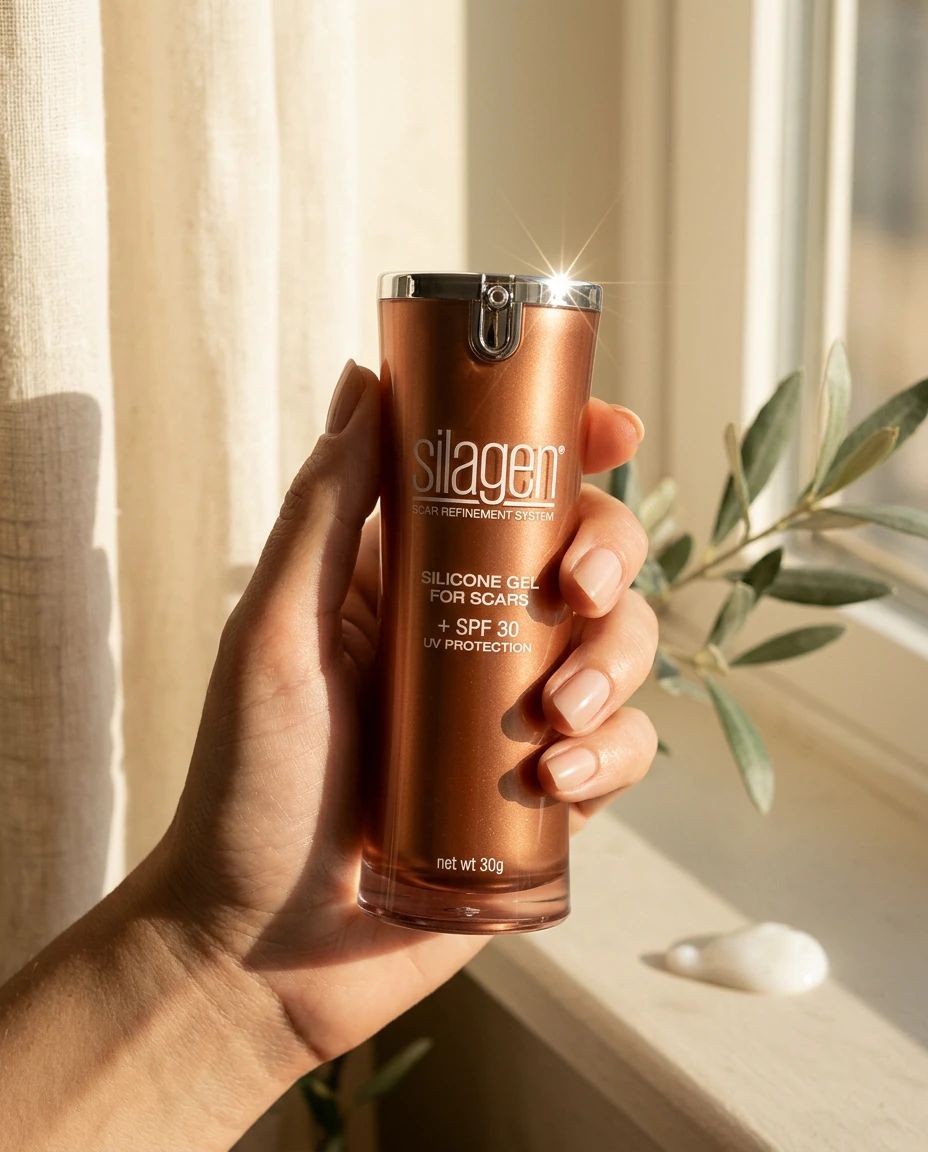
Hand holding a copper Silagen SPF gel bottle by a sunlit window

Where facelift scars sit

The exact path depends on the technique your surgeon uses.

  1. In front of the ear

    Where: Along the natural curve of the ear, sometimes inside the tragus

    Formats to ask about: Gel for a curved, visible line; SPF gel by day.

  2. Temple and sideburn

    Where: Into or along the hairline

    Formats to ask about: Gel is often discussed here, because sheets may not stay on hair-bearing skin.

  3. Behind the ear

    Where: In the crease behind the ear, sometimes into the scalp

    Formats to ask about: Gel; a trimmed strip only if your surgeon suggests it for a smooth stretch.

  4. Under the chin (neck lift)

    Where: A short line in the chin crease

    Formats to ask about: Gel, or a small strip.

Formats to discuss with your surgeon

Practical considerations

Hair, styling and hair products

Keep gel to the scar line and let it dry before styling. Ask your surgeon when hair dye, sprays and heat tools are safe near the incisions.

Makeup over scars

Silagen’s gel directions allow cosmetics once the gel has dried. Ask when makeup is permitted on facial incisions.

Glasses and masks

Arms of glasses and mask loops rest near ear incisions. Gel is less likely than a sheet to be rubbed off.

Manufacturer example: facelift

One facelift case. Note that treatment started 4 weeks after surgery in this example — it is a source fact, not a recommended start date.

Face · SIL_0045

Facelift

Reported: Silicone Gel + SPF 30

Source caption (exact text)

4 weeks post-op, before treatment was started After 5 months of treatment FACELIFT SILAGEN GEL+SPF 30 PATIENT SUBMITTED PHOTOS SIL_0045 Right Right Left Left

Manufacturer-supplied; patient-submitted photographs. Individual results vary. Silagen Before and After Full Gallery 5-26.pdf, p. 12.

See these in the full results gallery

Watch: Gel + SPF 30

Silagen Silicone Gel + SPF 30 · 45 sec · Silagen

Reading summary of on-screen text

Background music; information appears as on-screen text. This is a summary, not a verbatim transcript.

  • Explains that the gel combines silicone with zinc oxide sunscreen, intended to protect scars from UV-related darkening.
  • Lists exposed areas such as the face, neck, chest, arms and hands.
  • Shows a manufacturer Mohs example at 3 days after surgery, then after 2 and 4 months of treatment.
  • Presents a “day and night” pairing: SPF gel by day, Pure gel at night.

Questions to ask your surgeon

  • Where exactly are my incisions, including in the hair?
  • When can I start gel on each section?
  • Should I use SPF gel during the day — and when can my scars see sun?
  • When can I wear makeup or color my hair?
  • Is there any massage you want me to do — or avoid?

Frequently asked questions

Why gel rather than sheets after a facelift?

Facelift scars curve around the ear and run into hair, where adhesive sheeting struggles to stay on. Your surgeon may still suggest a strip for a smooth section.

Do I need sunscreen on facelift scars?

Facial scars are exposed. Silagen designed its SPF gel for exposed areas; follow its Drug Facts for sun protection.

Source: Silagen + SPF 30 video (on-screen text)

Is the facelift example typical?

It is a single manufacturer-supplied, patient-submitted case. Results vary.

Is a facelift guide the same as eyelid surgery?

No — eyelid skin is thinner and close to the eye, which brings different precautions. See the eyelid surgery guide.

Get help with your recovery

Questions about your scar care?

Your surgeon’s instructions come first. A TRC Care Planner can help you organize questions for your surgical team and recovery arrangements.

Silagen states its products are sold through authorized medical offices, not online retailers. Ask your surgeon’s office, or ask TRC about your next step. TRC does not sell Silagen products on this site.

Educational information from manufacturer materials, not medical advice. Silagen® is a trademark of Newmedical Technology, Inc. Follow your surgeon’s instructions.